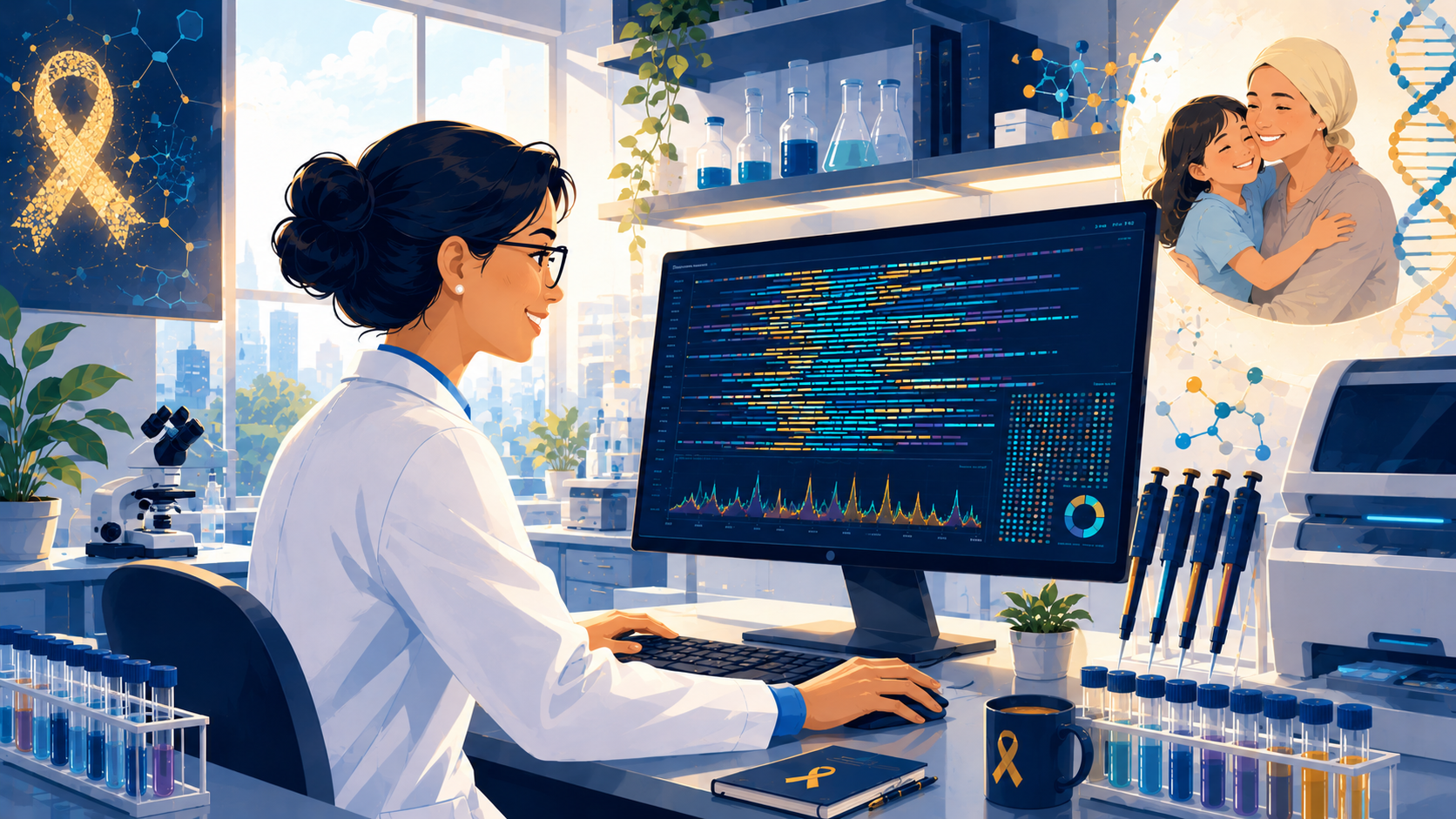
The Work That Saves Patients' Lives
Here is what I want people outside our field to understand about what happens in a molecular oncology lab, and what I want people inside our field to remember on the difficult days.
When a pathologist sends us a tumor specimen and asks for a comprehensive genomic panel, what comes back from our lab determines whether that patient gets standard chemotherapy or a targeted therapy designed for their specific mutation. An EGFR exon 19 deletion in a lung adenocarcinoma means that patient is eligible for osimertinib, a drug that dramatically outperforms standard chemotherapy in progression-free survival for that specific biology. We find that. We report that. The oncologist makes a different decision than they would have made without it.
BCR-ABL1 quantification in a CML patient on imatinib tells the treating physician whether the therapy is working, whether the patient is achieving major molecular response, whether dose adjustment is warranted. We generate that number. The physician reads it. The patient's treatment changes or doesn't change based on what we reported.
BRCA1 and BRCA2 testing in a patient with high-grade serous ovarian carcinoma: a pathogenic variant means PARP inhibitor eligibility, a fundamentally different treatment pathway, potentially years of additional effective therapy. We identify that variant. We classify it. The analysis we produce is what the pathologist signs out.
The molecular scientist's interpretation is embedded in every one of those clinical decisions. Yes, we run the instruments. But we are also the ones validating the methods, troubleshooting the failures, interpreting the data, and applying the scientific judgment that turns a raw result into something a physician can act on. That is not assembly line work. It is a discipline that requires clinical knowledge, analytical rigor, and a formal credential that says we are qualified to do it.
That is the work. And I think about how fortunate it is to be part of a field where what you do at the bench on a Tuesday morning can change the direction of someone's care that same week. Not many professions can say that. This one can, and most people in it never stop feeling the weight of that in the best possible way.
A Career That Is Genuinely Stable
Molecular diagnostics is one of the most stable career paths in healthcare. Not in the way people say "healthcare is stable" as a platitude. I mean structurally stable in ways that other healthcare roles are not.
Molecular testing has expanded continuously since the late 1990s and there is no realistic forecast in which it contracts. Next-generation sequencing alone created an entirely new category of clinical work that didn't exist a generation ago, and the complexity of that work has only increased. Automation is a real and growing part of this field: liquid handlers, automated extraction platforms, integrated workflows that move samples from input to result with minimal manual touch. That is not a threat to the profession. It is what makes higher throughput possible and it raises the floor on what trained professionals are expected to understand and oversee. Someone still has to validate the methods, monitor quality, troubleshoot failures, and interpret results in clinical context. Automation changes the shape of that work. It has not reduced the need for people who know what they are doing.
The MB(ASCP) positions you at the specialized end of that demand curve. It's not a generalist credential. It signals expertise in a specific, high-complexity domain at a moment when that domain is growing. Specialized and growing is about as close to structural job security as the labor market offers.
A National Certification and What It Can Lead To
The MB(ASCP) is a national certification issued by the American Society for Clinical Pathology Board of Certification. It certifies competency in molecular diagnostic methods, including nucleic acid isolation, amplification, sequencing, hybridization, and data interpretation across clinical applications in oncology, genetics, infectious disease, and identity testing. It is a credential, not a license. That distinction matters and is worth understanding clearly.
In most states, laboratory professionals are not individually licensed. They work under the CLIA certification of their laboratory. But some states go further and require professionals to hold a state-issued license to practice. California is one of them. The California Department of Public Health issues a specialty license called the Clinical Genetic Molecular Biologist Scientist (CGMBS) for professionals performing molecular biology diagnostic testing in CLIA-certified laboratories. To obtain it, you need a qualifying degree, documented training or work experience in clinical genetic molecular biology, and completion of a California state laws and regulations exam.
Here is where the MB(ASCP) connects: the California CDPH has approved the MB(ASCP) certification as a qualifying credential within the CGMBS application process. Holding it satisfies one recognized component of that application. It does not replace the other requirements, including the degree, the verified experience, and the state quiz. It does not automatically make you a licensed scientist. But it is an approved pathway element, and some California university training programs are structured specifically to help students earn both the MB(ASCP) and the CGMBS license on a concurrent timeline.
The broader point is this: the MB(ASCP) is a national credential that carries real weight at the state level in ways most candidates don't fully understand when they start studying for it. A state-issued license, separate from your employer and portable across institutions, is a meaningful thing in a field where expertise is often invisible to anyone outside the lab.
Who Pursues This Path
Maybe you're already in a molecular lab, running molecular assays and interpreting results, and the MB(ASCP) has been sitting on your list for years waiting for the right moment. Maybe you're finishing a clinical laboratory science degree and trying to figure out which specialty credentials exist and which ones are worth pursuing early. Maybe you're a laboratory technician looking to move into a training program and you're trying to understand what the professional landscape looks like before you commit to a direction. Or maybe this isn't for you at all, but you know someone who could benefit from it.
Wherever you're starting from, if you're drawn to this work, the MB(ASCP) is the credential that says so formally. In some states, like California, it also connects to a state-issued license that makes it official in the eyes of a licensing board.